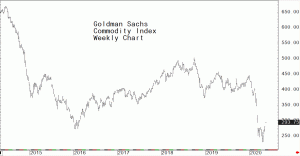
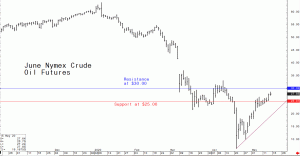
The Nymex crude oil futures market less than a month ago traded down to minus $40 a barrel. Since that time prices have rallied and are closing in on $30 a barrel. That’s impressive and if you do the math it’s the sharpest rally in the shortest timeframe in the history of oil futures market trading. Such are the times in which we are living. The strong recovery in the oil market is a good sign for the raw commodity sector that has been so hard-hit by the Covid-19 pandemic. Still, one has to remember that in January Nymex crude oil futures traded at $60 a barrel.–Stay tuned! Jim
Daily Morning Report
U.S. data Friday to show serious economic damage being inflicted from quarantining
Friday, May 15–Jim Wyckoff’s Morning Markets Report
Global stock markets were mostly firmer in overnight trading. U.S. stock indexes are pointed toward slightly higher openings when the New York day session begins. Many traders and investors are wondering how the U.S. stock market has rebounded so strongly, what with 36 million American workers losing their jobs in just two months’ time and a vast number of businesses and commerce still shuttered. Bigshot investment managers have gone on TV this week to say the U.S. stock market is presently the most over-valued they have ever seen it. However, these guys are likely just “talking their own book.” Still, the general public is taking a dim view of Wall Street recovering smartly, while main street continues to see major suffering. There are growing tensions as workers in the lower halves of nations’ income levels, who have seen the most job losses and who have the least amount of money saved, desperately need to get back to work but many governments won’t let them. This situation cannot go on for an extended period of time without civil unrest, which is already being seen in a few areas. This growing unease has likely helped gold get a better safe-haven bid recently.
In overnight news, the Euro zone first-quarter gross domestic product came in at -3.8% from the fourth quarter and down 3.2%, year-on-year.
Economic data released in China Friday was somewhat upbeat, showing that the world’s second-largest economy is recovering from the first-quarter quarantining of the public. However, a worrisome component of the data was that retail sales fell 7.5% in April, suggesting consumers, while back to work, are still leery about spending.
The important outside markets see Nymex crude oil futures higher early today and trading around $28.00 a barrel. The recent rally in the crude oil market has been a bullish element for the stock markets’ rallies. The U.S. dollar index is lower today. The yield on the benchmark U.S. Treasury 10-year note is currently around 0.62%.
There will be important U.S. economic data out Friday morning that will likely reflect the serious damage being inflicted upon the world’s largest economy. Due out are April retail sales (seen down around 12%), industrial production for April (seen down 11%), the University of Michigan consumer sentiment survey, the Empire State manufacturing survey, manufacturing and trade inventories, and Treasury international capital data.
–Jim
Continue Reading
Can stock markets continue to rebound as businesses remain shuttered and economies hobbled?
Thursday, May 14–Jim Wyckoff’s Morning Markets Report
Global stock markets were mixed to lower in overnight trading. U.S. stock indexes are pointed toward narrowly mixed openings when the New York day session begins. Traders and investors continue to assess and reassess the Covid-19 situation as it pertains to global, national and local economies. Human nature appears to be competing more and more with continued warnings from health experts–meaning people that have been cooped up for two months desperately want to get out and resume more normal lives, even though the pandemic is far from being under control and no vaccine is on the horizon.
The U.S. trading session will see the weekly jobless claims released, with the latest reading expected to show new claims of around 2.5 million. If that figure is realized, it would still be markedly down from weekly jobless numbers seen recently.
The marketplace takeaways so far this week include a growing number of economists now projecting longer recovery periods for major world economies, highlighted by Federal Reserve Chairman Jerome Powell Wednesday providing a grim picture of the U.S. economy and its path out of the pandemic. The other takeaway is a strong rebound in stock markets despite many main street businesses remaining shuttered and large segments of populations still in quarantine. How long can this juxtaposition last?
U.S.-China relations remain close to the front burner of the marketplace. The U.S. this week has accused China of hacking U.S. firms working on a Covid-19 vaccine. Given the already strained relations between the world’s two largest economies, it’s hard to imagine they will emerge from the current health crisis without profound and permanent changes in their relationship, including supply chains.
The important outside markets see Nymex crude oil futures higher early today and trading around $26.50 a barrel. The International Energy Agency Thursday said global oil demand in May will drop by 21.5 million barrels—outstripping the recent supply reductions. The U.S. dollar index is firmer today. The yield on the benchmark U.S. Treasury 10-year note is currently around 0.61%.
Other U.S. economic reports out Wednesday include import and export prices. Several Federal Reserve officials are scheduled to give speeches today.
–Jim
Continue Reading
Gold bulls remain in the driver’s seat
The gold futures market has seen choppy trading recently, but that price action has formed a bullish symmetrical triangle pattern that suggests another leg up in prices is coming soon. Bulls also have the longer-term technical advantage amid a longer-term price uptrend in place. “The trend is your friend” for the gold market bulls.–Stay tuned! Jim
Traders and investors still mostly upbeat at mid-week, but storm clouds loom
Wednesday, May 13–Jim Wyckoff’s Morning Markets Report
Global stock markets were mixed in overnight trading. U.S. stock indexes are pointed toward firmer openings when the New York day session begins. Traders and investors at mid-week are staying mostly upbeat despite increasing concerns about a second wave of Covid-19 infections hitting the world’s major economies that are starting to open back up. The top U.S. health official on Tuesday warned the U.S. Congress about the dangers of reopening the economy too early. Also, the specter of a renewed U.S.-China trade war, or worse, looms in the background after recent harsh rhetoric coming from both sides and directed at the other.
In overnight news, Eurozone factory output in March dropped 11.3% from February, which was a monthly record. Also, U.K. GDP dropped 2.0% in the latest quarter.
The marketplace will be watching Federal Reserve Chairman Jerome Powell in a morning webcast to an economics group, and especially wanting to hear this thoughts on U.S. interest rates that could fall into negative territory. President Trump tweeted Tuesday he could be in favor of such occurring. This matter is of special interest to precious metals traders, as the knock on investing in gold has been that it offers investors no dividend. Interest rates at or below zero work to eliminate the “opportunity cost” associated with owning precious metals.
The important outside markets see Nymex crude oil futures slightly lower early today and trading around $25.50 a barrel. The U.S. dollar index is slightly up today. The yield on the benchmark U.S. Treasury 10-year note is currently around 0.66%.
U.S. economic reports out Wednesday include the weekly MBA mortgage applications survey, the producer price index and the weekly DOE liquid energy stocks report.
–Jim
Continue Reading
Marketplace begins to reassess Covid-19’s ultimate impact on economies
Tuesday, May 12–Jim Wyckoff’s Morning Markets Report
Global stock markets were narrowly mixed in overnight trading. U.S. stock indexes are pointed toward slightly lower openings when the New York day session begins. Traders and investors are assessing the markets ramifications of a very possible “second wave” of the Covid-19 pandemic as major global economies start to reopen their businesses and transportation infrastructure. There is growing sentiment that economic recoveries will be slower than initially expected and which had been factored into current market prices, including the solid rallies in many global stock indexes. If marketplace notions continue to shift to slower economic recoveries it’s likely that many markets (especially the stock markets) will have to do some serious re-pricing—to the downside.
The Trump administration’s chief pandemic health official, Dr. Anthony Fauci, will testify before the U.S. Senate today and will warn of the high potential for infections to rise if the U.S. economy begins to reopen too early. Many states are starting to reopen more of their businesses. Government leaders have to walk a tightrope of balancing a likely increase of infections upon reopening businesses versus continued economic damage if they don’t, and that itself will take a significant human health toll. There is no single, correct solution to the matter. It’s a no-win situation for government leaders making those decisions.
The U.S. Federal Reserve late Monday announced it will begin buying corporate bond exchange traded funds (ETFs) for the first time ever, in a further effort to grease the skids of the U.S. financial system. It’s quite extraordinary to see the range of expectations of economists regarding the Covid-19-induced monetary policy stimuli from the major central banks and the future economic impact of such. Some economists forecast price inflation, some call for price deflation and others call for price “stagflation,” or higher inflation with little to no economic growth. Two markets to watch closely that will very likely provide a clue on which scenario will play out are crude oil and gold. If those markets push solidly higher on a sustained basis then inflation would be most likely. If they grind sideways or lower, deflation would most likely to be the case for an extended period of time. One should hope that inflation is the outcome, not because it is such a good thing, but because extended price deflation is a very bad thing for most markets. What do you think? Drop me an email at jim@jimwyckoff.com. I always enjoy hearing from my valued readers.
Speaking of inflation levels, or lack thereof, today’s U.S. consumer price index for April is due out and is expected to come in down 0.8% from March.
The important outside markets today see Nymex futures higher early today and trading around $25.00 a barrel. The U.S. dollar index is weaker today. The yield on the benchmark U.S. Treasury 10-year note is currently around 0.7%.
U.S. economic reports out Tuesday include the weekly Goldman Sachs and Johnson-Redbook retail sales reports, the NFIB small business index, the consumer price index, the monthly Treasury budget statement and real earnings.
–Jim
Continue Reading