The Euro currency futures market is seeing an accelerating price downtrend on the daily bar chart and late this week hit a new contract low. Bears are in solid near-term technical control and there are no signs of a market bottom being close at hand. Importantly for all you currency traders: Remember that trends in the currency markets tend to be stronger and longer-lasting than price trends in other markets. So just because the Euro has been pounded down hard recently, that does not mean more solid selling pressure is less likely. Stay tuned!–Jim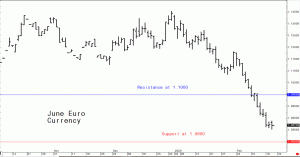
Daily Morning Report
China lowers interest rates to battle negative economic impact of coronavirus
Thursday, February 20–Jim Wyckoff’s Morning Markets Report
Asian and European shares were mixed overnight. U.S. stock indexes are pointed toward weaker openings when the New York day session begins, on some profit taking after the Nasdaq and S&P 500 indexes hit record highs Wednesday.
The coronavirus outbreak remains on or close to the front burner of the global marketplace, and today the concerns seem a bit greater. China’s central bank cut its one-year loan prime rate to 4.05% from 4.15% and the five-year loan rate to 4.75% from 4.80%. The move was not surprising and is an effort to keep the world’s second-largest economy afloat as the negative impact of the covid-19 outbreak is growing. China’s manufacturers are running out of needed materials and some have shut their doors. This situation is impacting global businesses and underscores the significance of the world supply chain that has many links in China.
There is now talk that with supply shortages of some commodities in China, those commodity prices could actually rise on the world market due to hoarding and China’s manufacturers scrambling to procure those commodities. Such talk is ironic given the coronavirus has worked to crimp global economic growth, including pushing several raw commodity prices lower on expectations for reduced demand for them.
The Federal Reserve said in its FOMC meeting minutes released Wednesday afternoon that it is closely monitoring the economic impact of the coronavirus outbreak.
Spot gold on some world markets hit a seven-year high overnight, on safe-haven demand.
While it’s been reported the rate of spread of the coronavirus (now called covid-19) has slowed significantly recently, other health experts say there is little sign of the virus easing due to its high contagion level. Reports said the Hubei province in China had around 350 new confirmed cases Wednesday, down from nearly 1,700 on Tuesday. Two covid-19 infected passengers of the cruise ship quarantined in Japan have died, with two Japanese government officials reported to have been infected.
The key outside markets today see crude oil prices near steady and trading around $53.25 a barrel. Meantime, the U.S. dollar index is up and hit another multi-month high in early U.S. trading. The greenback bulls have benefited greatly from safe-haven demand amid the heightened global uncertainty.
U.S. economic data due for release Thursday includes the weekly jobless claims report, the Philadelphia Fed business survey, leading economic indicators, and the weekly DOE liquid energy stocks report.
–Jim
Global risk aversion recedes a bit Wednesday
Wednesday, February 19–Jim Wyckoff’s Morning Markets Report
Asian and European shares were mixed but mostly firmer overnight. U.S. stock indexes are pointed toward higher openings when the New York day session begins. Risk aversion has receded a bit Wednesday. It appears the spread of the coronavirus illness (now officially called covid 19) to humans has slowed and that’s somewhat encouraging to the marketplace. However, the economic consequences of the outbreak are still playing out. What traders, investors, analysts and other market watchers are discovering is that the global supply chain sees many of its links in China, and with much of China still in quarantine, many global businesses—especially manufacturers–are suffering and may continue to do so for a while. The uncertainty regarding when the global supply chain will return to normal is likely to continue to squelch trader and investor risk appetite for at least the near term.
Gold prices have added to Tuesday’s solid gains and are at a six-week high. U.S. Treasuries are also in rally mode this week, on safe-haven demand.
The key outside markets today see crude oil prices higher and trading around $52.75 a barrel. Meantime, the U.S. dollar index is slightly up and hit another multi-month high in early U.S. trading. The greenback bulls have flexed their muscles lately, partly on safe-haven demand amid the heightened global uncertainty.
U.S. economic data due for release Wednesday includes the weekly MBA mortgage applications survey, the Goldman Sachs and Johnson Redbook weekly retail sales reports, the consumer price index, the producer price index, new residential construction, and FOMC minutes. Several Federal Reserve officials also are slated to give speeches today.
–Jim
Gold bulls enjoying price uptrend, safe-haven demand
The safe-haven gold market has been supported recently by the concern and anxiety caused in the marketplace by the coronavirus outbreak. Prices remain in choppy uptrend on the daily bar chart, suggesting the path of least resistance for prices will remain sideways to higher in the near term. Bulls remain in firm near-term technical control. Stay tuned!–Jim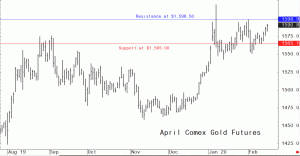
Global stock markets jittery as Apple says earnings will be hurt by coronavirus
Tuesday, February 18–Jim Wyckoff’s Morning Markets Report
Asian and European shares were mostly lower overnight. U.S. stock indexes are pointed toward lower openings when the New York day session begins. Risk aversion is keener in the marketplace on this first trading day of the week for U.S. traders and investors, following the President’s Day holiday Monday.
The U.S. marketplace is downbeat following news that Apple has issued a warning saying its first-quarter sales will be lower than initially expected due to the Coronavirus outbreak that has slowed or halted the delivery of Apple’s needed supplies coming from China. The rate of daily spread of the illness has slowed to the lowest since January, reports said. Over 1,800 people have died in China from the illness. The global supply chain has been significantly impacted, as seen by the Apple sales-miss news. Reports also said over 730 million in China are still effectively quarantined, suggesting supply-chain disruptions will continue as the world’s second-largest economy is presently crippled.
In other overnight news, the closely watched German ZEW economic expectations index dropped sharply in February, to 8.7 versus 26.7 in January. The coronavirus was blamed for most of the big decline in February.
The key outside markets today see crude oil prices lower and trading around $51.25 a barrel. Meantime, the U.S. dollar index is slightly up and hit a multi-month high in early U.S. trading.
U.S. economic data due for release Tuesday includes the Empire State manufacturing survey, the NAHB housing market index and Treasury international capital data.
–Jim
Traders tentative on a Friday, heading into uncertain weekend on coronavirus front
Friday, February 14–Jim Wyckoff’s Morning Markets Report
Asian and European shares were narrowly mixed overnight. U.S. stock indexes are pointed toward modestly higher openings and new record highs when the New York day session begins. Traders are tentative on this last trading day of the week and as U.S. market participants head into a three-day weekend, with the President’s Day holiday on Monday.
Here is the latest on the coronavirus outbreak: About 65,000 people around the globe have been afflicted with the virus, with China’s total now above 60,000. China’s hardest-hit Hubei province saw cases rise by over 4,800 on Friday. Some global shipping rates have fallen to record lows amid the outbreak, as some ships are being turned away at ports. One report said the Capesize index, which tracks freight rates for the largest carriers of dry bulk commodities, fell into negative territory last week for the first time since its creation over 20 years ago.
The annual London Metals Exchange (LME) Week Asia 2020 seminar has been postponed and the LME Asia Dinner has been cancelled due to the outbreak.
China’s central bank said in a statement Friday the effects of the coronavirus outbreak will only be temporary. The bank encouraged foreign investors to set up businesses in China.
The U.S. government on Thursday charged the big Chinese telecommunications giant Huawei with racketeering. The ramifications of this on U.S.-China relations and/or the U.S.-China trade deal signed in January, if any, are not clear.
The U.S. Treasury sold its 30-year bonds at a record-low yield of 2.061% Thursday, beating the previous record low auction yield of 2.17% set last fall. The lowest yield the 30-year bond has ever reached in daily trading is 1.941%, set last summer.
In other overnight news, the Eurozone fourth-quarter GDP was reported up 0.1% from the third quarter and up 0.9%, year-on-year. Those numbers were very close to market expectations.
The key outside markets today see crude oil prices higher and trading around $52.00 a barrel. Meantime, the U.S. dollar index is slightly up in early U.S. trading and hit a multi-month high overnight.
U.S. economic data due for release Friday includes retail sales, import and export prices, industrial production and capacity utilization, manufacturing and trade inventories and the University of Michigan consumer sentiment survey.
–Jim