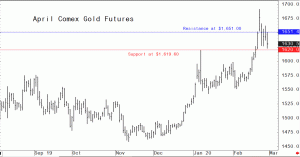
There is an old saying in trading markets that when times get really dire and anxiety is high, you don’t sell what you want, you sell what you can. Such is likely part of the reason safe-haven gold has seen some downside price pressure this week amid the meltdown in global stock markets. Also, remember that gold’s price is driven by consumer demand. China is a leading gold consumer, and the coronavirus outbreak’s negative impact on the Chinese economy is most certainly going to crimp Chinese citizens’ purchases of gold. Still, the gold bulls remain in firm near-term technical control amid a price uptrend in place on the daily bar chart and prices are not that far below the recent seven-year high.–Jim
Daily Morning Report
Marketplace remains on edge heading into an uncertain weekend
Friday, February 28–Jim Wyckoff’s Morning Markets Report
Global stock markets were solidly lower again Friday, the last trading day of the month, as the coronavirus outbreak continues to grip the global marketplace and is causing keen trader and investor anxiety. Here are just a few of the economic ramifications of the coronavirus outbreak, according to reports: China ports are seeing container ship calls down 30% from last year. Oil shipments to China from the Middle East are down 88% from last year’s February deliveries. The International Energy Agency forecasts oil demand to fall by 435,000 barrels a day in the first quarter–the first contraction in 10 years. U.S. stock indexes are pointed toward sharply lower openings and at multi-month lows when the New York day session begins.
Do not be surprised if, as soon as today, the major central banks of the world issue a joint statement declaring they stand ready to stimulate economies by easing their monetary policies, if the coronavirus scare continues to roil the markets. How the marketplace would interpret such a declaration is unclear. It could make market participants even more panicky.
The yield on the benchmark U.S. Treasury 10-year note has dropped to a record low of
1.17%. The 10-year German bond (bund) yield hit a five-month low of -0.616%. What the U.S. Treasury market is telling traders and investors this week is that serious economic damage will be inflicted by the coronavirus—both at home and abroad, including the possibility of a U.S. recession on the horizon. Europe’s economy stands to be hurt even worse by the outbreak.
Nymex crude oil prices solidly lower, at a 14-month low, and trading around $45.50 a barrel in early trading Friday. The U.S. dollar index is trading solidly down again today, as currency traders focus on the coronavirus prompting the Federal Reserve to lower interest rates as soon as March. President Donald Trump also bashed the Fed again this week and implied he wants a weaker greenback. The U.S. dollar, like, gold is a safe-haven asset, but both assets are feeling pressure late this week on the concerns associated with slowing economic growth. There’s an old saying that during an extremely anxious marketplace, traders don’t’ sell what they want, they sell what they can. Such is likely the case for gold this week.
U.S. economic data due for release Friday includes the advance economic indicators report, personal income and outlays, the Chicago ISM business survey, and the University of Michigan consumer sentiment survey.
–Jim
Global marketplace still very anxious Thursday, amid coronavirus outbreak
Thursday, February 27–Jim Wyckoff’s Morning Markets Report
Global stock markets were lower overnight as the coronavirus outbreak continues to spread and trader and investor fears continue to rise. The outbreak will significantly impact global growth for at least the first quarter of 2020, and maybe beyond. Prognosticators are trying to gauge the ultimate impact of the illness on the world economy but nobody really has a clue on the matter. That uncertainty is what is roiling the markets at present, and will likely continue to do so for the near term. U.S. stock indexes are pointed toward sharply lower openings when the New York day session begins.
President Trump held a news conference Wednesday evening and named Vice President Pence as heading up the U.S. effort to combat the illness and its spread. Trump also said he thinks U.S. equities are selling off because of the socialist-leaning Democratic presidential candidates.
The yield on the benchmark U.S. Treasury 10-year note on Thursday fell to a record low of
1.29%. There’s an old market adage that “the bond market knows and stock traders are schmoes.” U.S. Treasury yields started falling last week, before the big sell off in the global stock markets. What the U.S. Treasury market is telling traders and investors now is that serious economic damage will be inflicted by the coronavirus—both at home and abroad, including the possibility of a U.S. recession on the horizon.
Most market watchers now expect future easing of monetary policies by the major central banks of the world, to stimulate their economies and help ward off the negative economic impacts of the coronavirus outbreak.
Nymex crude oil prices lower, at a 14-month low, and trading around $47.60 a barrel in early trading Thursday. The U.S. dollar index is trading down today.
U.S. economic data due for release Thursday includes the weekly jobless claims report, the second estimate of fourth-quarter gross domestic product, pending homes sales, the Kansas City Fed manufacturing survey, and durable goods orders.
–Jim
Stick a fork in the U.S. stock indexes–they are done
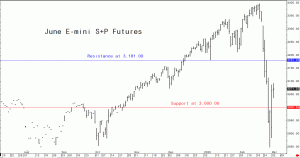
The U.S. stock indexes have been hammered this week. On Monday prices gapped sharply lower on the daily bar charts and then on Tuesday saw strong follow-through selling pressure–a solid signal that near-term market tops are in place. Stay tuned to my daily market reports, which will provide you with the early clues on when the blood-letting in the U.S. stock indexes will stop, so keep reading them!–Jim
Coronavirus-generated turmoil in marketplace continues at mid-week
Wednesday, February 26–Jim Wyckoff’s Morning Markets Report
Global stock markets are lower at mid-week as the coronavirus outbreak and its expected human toll and negative world economic fallout continue to intensify. There is no consensus on how or when this situation will wind up playing out. That suggests turmoil in the markets will continue in varying degrees until some kind of end-game for the matter is expected by the majority of market watchers. U.S. stock indexes are pointed toward firmer openings when the New York day session begins. The DJIA on Monday and Tuesday saw its largest two-day drop in history, points-wise. The S&P 500 futures hit a three-month low overnight.
The U.S. Center for Disease Control officials at a press conference on Tuesday afternoon said of the outbreak: “This might be bad.” The CDC said the Covid-10 illness is going to spread in the U.S. The outbreak continues to spread in Asia and Europe.
In a sign of the keen trader and investor anxiety in the global marketplace at present, the yield on the benchmark U.S. Treasury 10-year note on Tuesday fell to a record low close of 1.328%. On Wednesday the yield traded as low as 1.312%. Gold is near steady Wednesday after falling sharply Tuesday. The big drop in gold prices Tuesday could be tied to notions of less consumer demand for the metal as global economic growth is dinged by the coronavirus outbreak. China, where the illness has hit hardest, is a leading consumer of gold.
The key outside markets today see Nymex crude oil prices lower, at a nearly 14-month low, and trading around $49.50 a barrel. Brent crude is also trading near a 14-month low. Meantime, the U.S. dollar index is higher today.
Financial and currency markets this week are pricing in expected future easing of monetary policies by the major central banks of the world, as traders reckon the coronavirus, or covid-19, illness will prompt the central banks to stimulate their economies to help ward off the negative economic impacts of the outbreak.
U.S. economic data due for release Wednesday includes the weekly MBA mortgage applications survey, new residential sales and the weekly DOE liquid energy stocks report.
–Jim
Global markets stabilize Tuesday…for the moment
Tuesday, February 25–Jim Wyckoff’s Morning Markets Report
Global stock markets have stabilized and are trading mixed Tuesday, following Monday’s strong selling pressure that wiped out all of the U.S. stock market’s gains for 2020, including seeing the Dow Jones Industrial Average lose over 1,000 points. U.S. stock indexes are pointed toward slightly higher openings when the New York day session begins. The key questions on traders’ and investors’ minds are: Have the markets now fully factored in the coronavirus impact on the global economy? Or, “will the next shoe drop” soon?
Here is the latest on the coronavirus outbreak (covid-19). China has over 80,000 confirmed cases, with 508 new cases Tuesday and 71 new deaths to push the total above 2,700. Reports say China may postpone its annual National People’s Congress in March. More than 1,200 cases have been confirmed in 30 countries outside of China. South Kore has 84 new cases and nine deaths. A crew member of Korean Air has tested positive for coronavirus. Northern Italy sees 12 towns quarantined amid 229 cases confirmed and seven deaths. Japan has 160 coronavirus cases. Still, the World Health Organization says it is too early to call the outbreak a pandemic, although other health experts are calling it such. United Airlines says U.S. citizens traveling to China are now near zero.
Financial and currency markets are starting to price in expected future easing of monetary policies by the major central banks of the world, due to the covid-19 outbreak. Fed funds futures markets show an 86% chance the Federal Reserve will lower U.S. interest rates by July. The 10-year U.S. Treasury Note yield is nearing a historic low and is currently fetching around 1.35%.
The key outside markets today see crude oil prices lower and trading around $51.00 a barrel. Meantime, the U.S. dollar index is slightly lower but not too far below last week’s nearly three-year high.
U.S. economic data due for release Tuesday includes the weekly Johnson Redbook and Goldman Sachs retail sales reports, the monthly house price index, the S&P-Case-Shiller home price index, the Richmond Fed business survey, and the consumer confidence index.
–Jim