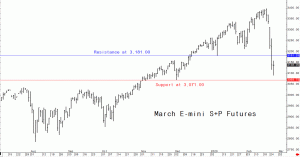
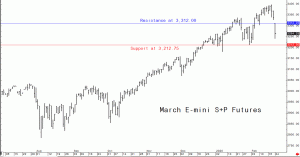
The U.S. stock indexes took another bearish technical hit Monday when prices gapped sharply lower on the daily bar chart–a warning signal that a near-term market top is in place. Can the bulls overcome yet another near-term bearish clue of a top? They have done so in the recent past. However, this bearish clue is the strongest one yet, to signal a market peak. Price action the rest of this week will likely go a long way in determining of the U.S. stock market has put in a near-term top. My daily market reports will provide you with the near-term clues on price direction and trend changes, so keep reading them!–Jim
Daily Morning Report
Coronavirus outbreak spreading, markets worldwide rocked amid the keen uncertainty and fear
Monday, February 24–Jim Wyckoff’s Morning Markets Report
Markets worldwide are getting rocked by a marked increase over the weekend in trader and investor fears amid the still-growing coronavirus outbreak. Gold is up around $40 an ounce and at a seven-year high, U.S. Treasuries are rallying sharply, the U.S. dollar index is up, crude oil prices are sharply down and much of the rest of the raw commodity sector is feeling selling pressure. Asian and European shares were down overnight. U.S. stock indexes are pointed sharply lower openings when the New York day session begins, with the DJIA down over 700 points.
While the human toll from the coronavirus (covid-19) is growing, the likely economic toll also is expanding. What is gripping markets is the keen uncertainty of how this situation will eventually play out. There is no consensus at all regarding the outcome.
China recorded the total number of afflicted at over 77,000 and over 2,350 dead. The illness is also spreading in South Korea. Northern Italy has some towns quarantined after the covid-19 illness was discovered spreading in that region, including three deaths.
Manufacturing indexes from the major world economies are showing the negative effects of the covid-19 outbreak. U.S. companies are also mentioning the illness as impacting their bottom lines when earnings reports are released. The global marketplace has quickly realized early this year the keen importance of China’s economy in the world supply chain, which has been significantly disrupted.
The key outside markets today see crude oil prices sharply lower and trading around $51.40 a barrel. Meantime, the U.S. dollar index is higher and not far below last week’s nearly three-year high.
U.S. economic data due for release Monday includes the Chicago Fed national activity index and the Texas manufacturing outlook survey.
–Jim
Risk-averse marketplace to end the trading week Friday
Friday, February 21–Jim Wyckoff’s Morning Markets Report
Asian and European shares were mostly down overnight. U.S. stock indexes are pointed toward weaker openings when the New York day session begins. Risk-off trading attitudes are keen as the trading week winds down, as the coronavirus continues to spread in Asia, and its impact on the global economy is perceived to be getting much more serious.
Reports overnight said China’s auto sales fell over 90% in February as coronavirus restrictions prevented buyers from visiting car dealerships. Over 21 million autos were sold in China in 2019, making China the world’s largest auto market. The Hubei province is still in lock-down and officials there have pushed back the date for businesses to reopen to 10 March. That date could be further delayed if covid-19 is not contained by then.
China recorded over 800 new cases Thursday (up from around 400 Wednesday), with the total number of afflicted now at over 75,000 and over 2,200 dead. South Korea has reported over 200 confirmed covid-19 cases. The capital has banned all rallies in major downtown areas.
From a marketplace perspective the covid-10, or coronavirus, situation is still very fluid regarding the economic impact on major world economies. Traders and investors are vacillating daily on whether the outbreak’s rate of spread is accelerating or declining. This uncertainty will continue to support buying interest in safe-haven assets like gold, U.S. Treasuries and the U.S. dollar, and the movement of money out of riskier assets like stocks. Gold prices hit another seven-year high of around $1,640 overnight.
Manufacturing indexes from the major world economies are starting to show the negative effects of the covid-19 outbreak. U.S. companies are also mentioning the illness as impacting their bottom lines when earnings reports are released.
The key outside markets today see crude oil prices lower and trading around $52.75 a barrel. Meantime, the U.S. dollar index is weaker on a corrective pullback after hitting a multi-month high Thursday.
U.S. economic data due for release Friday includes the US flash manufacturing PMI, the services PMI, and existing home sales.
–Jim
Euro currency getting hammered, no signs of market bottom close at hand
The Euro currency futures market is seeing an accelerating price downtrend on the daily bar chart and late this week hit a new contract low. Bears are in solid near-term technical control and there are no signs of a market bottom being close at hand. Importantly for all you currency traders: Remember that trends in the currency markets tend to be stronger and longer-lasting than price trends in other markets. So just because the Euro has been pounded down hard recently, that does not mean more solid selling pressure is less likely. Stay tuned!–Jim
China lowers interest rates to battle negative economic impact of coronavirus
Thursday, February 20–Jim Wyckoff’s Morning Markets Report
Asian and European shares were mixed overnight. U.S. stock indexes are pointed toward weaker openings when the New York day session begins, on some profit taking after the Nasdaq and S&P 500 indexes hit record highs Wednesday.
The coronavirus outbreak remains on or close to the front burner of the global marketplace, and today the concerns seem a bit greater. China’s central bank cut its one-year loan prime rate to 4.05% from 4.15% and the five-year loan rate to 4.75% from 4.80%. The move was not surprising and is an effort to keep the world’s second-largest economy afloat as the negative impact of the covid-19 outbreak is growing. China’s manufacturers are running out of needed materials and some have shut their doors. This situation is impacting global businesses and underscores the significance of the world supply chain that has many links in China.
There is now talk that with supply shortages of some commodities in China, those commodity prices could actually rise on the world market due to hoarding and China’s manufacturers scrambling to procure those commodities. Such talk is ironic given the coronavirus has worked to crimp global economic growth, including pushing several raw commodity prices lower on expectations for reduced demand for them.
The Federal Reserve said in its FOMC meeting minutes released Wednesday afternoon that it is closely monitoring the economic impact of the coronavirus outbreak.
Spot gold on some world markets hit a seven-year high overnight, on safe-haven demand.
While it’s been reported the rate of spread of the coronavirus (now called covid-19) has slowed significantly recently, other health experts say there is little sign of the virus easing due to its high contagion level. Reports said the Hubei province in China had around 350 new confirmed cases Wednesday, down from nearly 1,700 on Tuesday. Two covid-19 infected passengers of the cruise ship quarantined in Japan have died, with two Japanese government officials reported to have been infected.
The key outside markets today see crude oil prices near steady and trading around $53.25 a barrel. Meantime, the U.S. dollar index is up and hit another multi-month high in early U.S. trading. The greenback bulls have benefited greatly from safe-haven demand amid the heightened global uncertainty.
U.S. economic data due for release Thursday includes the weekly jobless claims report, the Philadelphia Fed business survey, leading economic indicators, and the weekly DOE liquid energy stocks report.
–Jim
Global risk aversion recedes a bit Wednesday
Wednesday, February 19–Jim Wyckoff’s Morning Markets Report
Asian and European shares were mixed but mostly firmer overnight. U.S. stock indexes are pointed toward higher openings when the New York day session begins. Risk aversion has receded a bit Wednesday. It appears the spread of the coronavirus illness (now officially called covid 19) to humans has slowed and that’s somewhat encouraging to the marketplace. However, the economic consequences of the outbreak are still playing out. What traders, investors, analysts and other market watchers are discovering is that the global supply chain sees many of its links in China, and with much of China still in quarantine, many global businesses—especially manufacturers–are suffering and may continue to do so for a while. The uncertainty regarding when the global supply chain will return to normal is likely to continue to squelch trader and investor risk appetite for at least the near term.
Gold prices have added to Tuesday’s solid gains and are at a six-week high. U.S. Treasuries are also in rally mode this week, on safe-haven demand.
The key outside markets today see crude oil prices higher and trading around $52.75 a barrel. Meantime, the U.S. dollar index is slightly up and hit another multi-month high in early U.S. trading. The greenback bulls have flexed their muscles lately, partly on safe-haven demand amid the heightened global uncertainty.
U.S. economic data due for release Wednesday includes the weekly MBA mortgage applications survey, the Goldman Sachs and Johnson Redbook weekly retail sales reports, the consumer price index, the producer price index, new residential construction, and FOMC minutes. Several Federal Reserve officials also are slated to give speeches today.
–Jim