February Nymex crude oil prices spiked to a nine-month high of $65.65 on Wednesday and then came crashing back down to score a big and bearish “outside day” down on the daily chart that suggests a near-term market top is in place. Now, the bulls need to defend the uptrend line on the daily chart Stay tuned!–Jim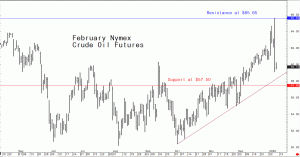
Daily Morning Report
Global stocks rally as U.S.-Iran stand down on military conflict
Thursday, January 9–Jim Wyckoff’s Morning Markets Report
Risk appetite has quickly returned to the global marketplace Thursday, on ideas the U.S. and Iran have stepped back from the brink of an escalating military conflict that had been brewing for months. Statements coming from the U.S. and Iran strongly suggested such the past 24 hours, including President Trump saying Iran is “standing down.” Most don’t at all expect the U.S. and Iran to become friendly, but more likely is Iran’s clandestine operations against the U.S. that have been carried on by Iran and its proxies for years. Meantime, the U.S. will continue to put the screws to Iran by harsh economic sanctions and working to prevent the nation from developing a nuclear weapon.
Global stock markets have rallied Thursday. U.S. stock indexes are pointed toward firmer openings and at record highs when the New York day session begins. Gold prices have backed down from the spike seven-year highs seen early Wednesday, while Nymex crude oil prices have also come down from a spike high and are trading around $59.75 a barrel.
Traders and investors are getting back to examining economic data and other market fundamentals, including awaiting Friday morning’s December U.S. employment situation report from the Labor Department. Wednesday’s stronger-than-expected ADP national employment report has some leaning toward a stronger non-farm jobs number in Friday’s report, which has been forecast to come in at up 160,000.
Global stock markets were also buoyed Thursday on reports China has confirmed it will sign a “Phase 1” trade deal with the U.S. next week. China’s senior trade official will travel to Washington, D.C. for the signing. A partial trade deal between the world’s two largest economies should work to boost global economic growth in 2020.
In overnight news, the Euro zone jobless rate was reported at 7.5% in November, unchanged from October and in line with market expectations.
Inflation in China picked up and hit an eight-year high, at up 2.9% in 2019. The main culprit was rising pork prices due to major disease decimating China’s hog herd.
The World Gold Council has reported world central banks bought a net 41.8 metric tons of gold in October. That was 16% lower than in September and 29% below August. However, analysts believe the gold purchase pace from the central banks will pick up in 2020.
U.S. economic data due for release Thursday includes the weekly jobless claims report and the monthly chain store sales index. Several Federal Reserve officials are also slated to give speeches Thursday.
–Jim
Global markets rocked by Iran missile attack on U.S. troop in Iraq, but then settle down
Wednesday, January 8–Jim Wyckoff’s Morning Markets Report
Global markets that were open Tuesday evening U.S. time were rocked when Iran launched at least a dozen missiles at military bases in Iraq where U.S. troops were stationed. Iran immediately claimed responsibility for the attacks, which it called “hard revenge” for the U.S. killing of its leading military general last week. Reports say there are no U.S. casualties. President Trump tweeted “all is well” and said he would have more to say today. At first blush, it appears the Iranian leadership launched the missiles to appease Iranian citizens who were calling for revenge. However, it also appears Iran did not want to kill Americans which would then likely see a massive U.S. retaliation. Reports also said Iranian officials notified the U.S. the missile strikes were coming. Military analysts believe Iran’s missiles are accurate enough to have inflicted more loss of human life, if that’s what Iran’s leaders wanted. But that’s still just speculation. Iran’s leadership did say the missile attacks were “proportionate” and said they did not want an escalation of the conflict. The wildcard is, how will Trump respond? The marketplace Wednesday morning is acting like this situation will de-escalate from here, at least for the near term.
Gold prices spiked to a nearly seven-year high of $1,613.30 on initial news of the Iranian missile attack. Crude oil spiked to a nine-month high of $65.65, basis Nymex crude oil futures. U.S. Treasury prices rallied on the initial news, while U.S. stock indexes sold off sharply. However, once it appeared there were no U.S. casualties in the Iranian attack, global markets began to settle down. Gold prices are now just moderately up and oil is slightly higher. Asian and European stock markets were weaker overnight.
Right now, U.S. stock indexes are pointed toward narrowly mixed openings when the New York day session begins. Nymex crude oil prices are trading around $63.00 a barrel and the U.S. dollar index is modestly up.
The other news overnight is the crash of a Ukrainian Boeing 737 jet airliner in Iran that killed over 170 people. Right now, Iranian authorities are saying the cause of the crash is mechanical issues. This plane was not the 737 Max that has been grounded for almost a year.
U.S. economic data due for release Wednesday includes the weekly MBA mortgage applications survey, the ADP national employment report, and the weekly DOE liquid energy stocks report.
–Jim
Risk aversion at least temporarily recedes Tuesday
Tuesday, January 7–Jim Wyckoff’s Morning Markets Report
Asian and European stock markets were mostly firmer overnight. U.S. stock indexes are pointed toward narrowly mixed openings when the New York day session begins. It appears risk aversion in the global marketplace has at least temporarily subsided following last week’s geopolitical shockwave that occurred when a U.S. drone strike killed a leading Iranian general in Baghdad, Iraq. U.S. stock indexes rebounded Monday to close firmer. Gold and oil prices have backed down from their spike highs scored on Monday.
It could be that many traders and investors figure Iran will not execute a major retaliation against the U.S. and its vaunted military, knowing such a move would invite a likely massive and devastating counter-attack from the U.S.—as was threatened by President Trump in a weekend tweet. Other veteran market watchers reckon Iran will retaliate against the U.S. but not right away. However, virtually all market participants agree the U.S. drone strike further stokes and already volatile Middle East.
In overnight news, the Euro zone December consumer price index was reported up 1.3%, year-on-year, versus November’s reading of up 1.0%. The December reading was in line with market expectations.
The key “outside markets” today see crude oil prices weaker and trading around $63.00 a barrel. Meantime, the U.S. dollar index is firmer.
U.S. economic data due for release Tuesday includes the weekly Goldman Sacs and Johnson Redbook retail sales reports, U.S. international trade data, the ISM non-manufacturing report on business, and manufacturers’ shipments and inventories.
–Jim
S&P emini bulls dodge a technical bullet
The S&P emini futures have seen a “key reversal” down on the daily bar chart that occurred last Friday negated with this week’s upside price action. It appears risk aversion in the global marketplace has at least temporarily subsided following last week’s geopolitical shockwave that occurred when a U.S. drone strike killed a leading Iranian general in Baghdad, Iraq. U.S. stock indexes rebounded Monday to close firmer. Gold and oil prices have backed down from their spike highs scored on Monday. It could be that many traders and investors figure Iran will not execute a major retaliation against the U.S. and its vaunted military, knowing such a move would invite a likely massive and devastating counter-attack from the U.S.—as was threatened by President Trump in a weekend tweet. Other veteran market watchers reckon Iran will retaliate against the U.S. but not right away. However, virtually all market participants agree the U.S. drone strike further stokes and already volatile Middle East. Stay tuned!–Jim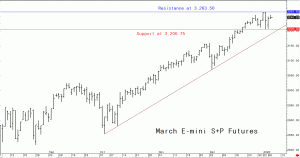
Biggest geopolitical threat in years rattles global investor confidence
Monday, January 6–Jim Wyckoff’s Morning Markets Report
Global stock markets are still reeling on geopolitical fears following the U.S. drone strike late last week that killed Iran’s leading military figure. Asian and European stocks were down overnight and the U.S. stock indexes are set to open the New York day session with solid losses.
Gold prices are again sharply higher Monday and hit a nearly seven-year high overnight, at $1,590.90, basis nearby Comex futures. The key “outside markets” today see crude oil prices higher and at a 22-month high, after hitting $64.72 a barrel overnight. Meantime, the U.S. dollar index is weaker amid a five-week-old downtrend in place on the daily bar chart.
The weekend saw more saber-rattling from the U.S. and Iran. President Trump tweeted that the U.S. has 52 Iranian sites set for attack if Iran retaliates against the U.S. for the killing of its general. Meantime, Iraqi’s government voted to expel U.S. troops from Iraq, which prompted a response from Trump that the U.S. would impose economic sanctions on Iraq if such occurred. Nations around the globe issued proclamations urging restraint on the matter from both the U.S. and Iran. This is arguably the most serious geopolitical development in many years, and whose repercussions will play out for a long time to come. That will likely keep trader and investor risk aversion elevated for some time to come. That’s bullish for safe-haven assets like precious metals and U.S. Treasuries.
In other overnight news, the Euro zone producer price index for December came in at up 0.2% on the month and down 1.4%, year-on-year. Very low inflationary pressures in the world’s major economies continues to be a concern for the major central banks of the world.
U.S. economic data due for release Monday includes the U.S. services purchasing managers’ index (PMI) and the global PMI.
–Jim