• Skip to main content
  • Skip to footer

Jim Wyckoff

Dominate Your Market

  • Daily Morning Report
  • Meet Jim
    • Testimonials
  • Contact Jim
  • Sample Reports and Charts
  • FAQ
  • Jim’s educational e-books

Daily Morning Report

Marketplace a bit calmer now; Friday a very important trading day for trader psychology

March 20, 2020 by Jim Wyckoff

Friday, March 20–Jim Wyckoff’s Morning Markets Report

Global stock markets were mostly higher in overnight trading. U.S. stock index futures are presently pointed toward solidly higher openings when the New York day session begins. Trading today will be extra important for the marketplace, from a psychological perspective. After Thursday’s gains, if the U.S. stock indexes can on Friday put together a two-day winning streak for the first time in weeks, then many traders and investors will head into the weekend thinking the markets panic has now passed and most markets have at least stabilized.

Make no mistake, the economic and human toll from the Covid-19 pandemic will continue to rise, and likely dramatically on both counts. California is headed for a complete lockdown of its citizens, and some health officials are predicting the most populous state in the U.S. (and the world’s fifth- largest economy) will see up to half of its population infected by the illness.
Many economists are now saying U.S. GDP will drop by over 10% for at least one quarter—and that could be light, given most U.S. stores are presently shuttered.

Two key markets, U.S. Treasuries and gold, are late this week providing key clues the marketplace panic is over and that markets are stabilizing–even if there is more downside in the stock market and much more downside in the global economy in the coming weeks.

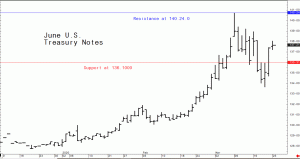
The U.S. Treasury bond futures market has seen prices rebound solidly late this week (yields falling). It appears the U.S. Treasury market has become more liquid as the week has progressed. Treasury buyers are stepping back into the fray with more confidence in the bond market. It seems contradictive that bond yields would be falling while trader and investor fears are easing a bit. However, the rally in the Treasury futures and falling yields in the cash market suggest more economic and stock market damage are expected by bond traders, and thus the safe-haven moves to own U.S. Treasuries. The benchmark U.S. 10-year Treasury note yield was trading around 1.04% Friday morning.

The same goes for gold. Prices are rallying Friday as more confident buyers are stepping in after the yellow metal had been pounded down recently on a “sell what you can” trader mentality that also pervaded many markets earlier this week. The buying in gold late this week is also likely safe-haven demand, along with short covering in the futures market following the recent big losses.

The U.S. dollar index early Friday morning has backed down from its massive gains seen this week that saw the USDX hit a three-year high. It’s likely just a corrective pullback and certainly not signal the USDX has hit a peak. The rush to hold greenbacks has further roiled an already anxious foreign exchange market. This week’s price action in the USDX reaffirms the U.S. dollar’s status as the supreme-quality asset to own when times get really, really tough.

Nymex crude oil futures prices are solidly up again early today and have made a dramatic rebound after hitting an 18-year low of $20.06 a barrel on Wednesday. Crude prices are currently trading around $27.50 a barrel. The huge rebound in crude late this week does suggest that important market has put in a price bottom.

U.S. economic data due for release Friday includes is light and includes existing home sales. In a sign of the times, this week’s Federal Reserve FOMC meeting came and went with nary a mention on the business news channels and completely ignored by the marketplace. The Fed has been actively intervening in the markets all week, including last weekend’s surprise interest rate cut.

–Jim
Continue Reading

Filed Under: Blog News, Jim's Morning Report, Uncategorized

Bruised global marketplace seeks refuge in U.S. dollar

March 19, 2020 by Jim Wyckoff

Thursday, March 19–Jim Wyckoff’s Morning Markets Report

Global stock markets were mixed in overnight trading, with Asian shares mostly down and European shares mostly up. U.S. stock index futures are presently pointed toward weaker openings when the New York day session begins. The coronavirus pandemic continues its stranglehold on the global marketplace. China did report overnight that there were no new reported cases of the illness in that country Thursday, although many wonder about the outbreak statistics’ veracity coming from the Chinese government.

Look for another volatile day in many markets. Speaking of volatility, the VIX index (called the volatility index) this week hit record highs above 80.0. For perspective, the European Union debt and financial crisis of a few years ago saw the VIX climb to 30.0, which at that time had the marketplace alarmed.

Following is an edited email dispatch from a market analyst, received this morning: “With fears over the spread of coronavirus intensifying, it’s reasonable and justified to see risk assets being sold aggressively. After all, the consequences on the global economy and corporate earnings may be enormous, depending on the duration of the pandemic. But what’s interesting in the current market turmoil is that even the safest assets in financial markets, U.S. government bonds, are being sold-off. In a bear market, traditionally investors have flocked to U.S. Treasury bonds, which historically have been inversely correlated to stock markets. In fact, we did see tremendous inflows into Treasuries at the beginning of the coronavirus outbreak. From mid-February to early March, yields on the 10-year Treasury bond declined by 80% to reach a record low of 0.32%. However, over the last several days this pattern has changed, with the sell-off in US Treasuries intensifying, especially on Tuesday and Wednesday with yields reaching 1.25%. This kind of market behavior is scary. It shows that investors are selling whatever they can to raise cash, and this also explains why the U.S. dollar is soaring to new highs. Investors are clearly being forced to build their cash reserves in order to survive a prolonged period of the current pandemic.”

In overnight news, the European Central Bank stepped in and said it would buy 750 billion Euros in securities to liquify the European financial system. The ECB labeled the effort the “Pandemic Emergency Purchase Program.”

After the markets closed Wednesday the Federal Reserve added still more short-term liquidity to the U.S. financial system. The U.S. government is set to unveil a financial assistance package to American citizens and businesses.

The U.S. dollar index is higher again in early U.S. trading and hit another three-year high. The world marketplace has seen confirmation that the greenback is still king when times get really tough. Nearly everyone who can wants to hold U.S. dollars as a safe-haven store of value. The big grab for greenbacks is perpetuating dislocations in the financial markets but there is a positive element from this week’s reaffirmation of supreme global confidence in the U.S. currency: The U.S. is about to possibly double its already record-large federal deficit due to expected company bailouts and financial assistance packages. At first blush, it appears the world’s investors will be very willing to purchase that big influx of U.S. government debt issuance.

The U.S. Treasury bond futures market has rebounded Thursday morning, from Wednesday’s major sell off. The benchmark U.S. 10-year Treasury note yield was trading around 1.2%–well up from levels well below 1.0% seen last week.

Nymex crude oil futures prices are solidly up after hitting an 18-year low of $20.06 a barrel on Wednesday. Crude prices are currently trading around $22.85 a barrel. One bright spot for the U.S. consumer is that unleaded gasoline futures wholesale price from the refinery is now trading at 68 cents a gallon—suggesting much lower gasoline prices at the pump heading into spring and summer.

U.S. economic data due for release Wednesday includes the weekly jobless claims report, which in the coming weeks will become a major data point—likely showing massive increases from normal numbers. Other reports Thursday include the Philadelphia Fed business survey and leading economic indicators.

–Jim

Continue Reading

Filed Under: Blog News, Jim's Morning Report, Uncategorized

Markets still in panic mode at mid-week, despite massive U.S. government aid measures

March 18, 2020 by Jim Wyckoff

Wednesday, March 18–Jim Wyckoff’s Morning Markets Report

Global stock markets were down in overnight trading and U.S. stock index futures are presently pointed toward sharply lower to limit-down openings when the New York day session begins.

A more-than-$1 trillion U.S. aid package for U.S. consumers and businesses is so far not assuaging trader and investor confidence at mid-week. Instead, they are considering the consequences of a North American way of life that has been turned upside down. Most retail businesses, schools and universities are closed and streets are seeing much less traffic. Major corporations such as Boeing and U.S. airlines are teetering on bankruptcy. The U.S. Treasury and commercial paper markets are not functioning well despite massive infusions of funds from the Federal Reserve. U.S. Treasury Secretary Mnuchin on Tuesday warned the U.S. unemployment rate could reach 20%. Considering all of the above and knowing that markets have historically factored into their prices major events’ repercussions before they ever fully play out, veteran market watchers are wondering when the worst of this crisis will come to pass, from a markets perspective. At mid-week it appears the markets are saying, “not yet.”

There was some hope late Tuesday that the sharp rise in the 10-year U.S. Treasury note yield back above 1.0% was indicating the government bond market was reckoning the worst of the coronavirus market damage has passed and that the panic in the marketplace had receded. However, looking at the sharply lower U.S. Treasury bond and Treasury note futures prices overnight it appears the rising bond yields are more a case of serious dislocations in that market as opposed to an easing of trader and investor market fears. Wednesday morning the 10-year Treasury note was yielding 1.13%.

The U.S. dollar index is higher in early U.S. trading and has this week hit a three-year high. Nymex crude oil futures prices are solidly down and hit a 17-year low of $25.08 a barrel overnight.

Reports said one U.S. hedge fund manager, Malachite, Management LLC, has closed down, citing “extreme, adverse market conditions.” Reports said the firm specialized in trading volatility. Apparently in these trying times at least one firm should not get what one asks for.

The Commodity Futures Trading Commission has relaxed some of its rules for brokerages, to help them deal with the extreme markets moves that are occurring daily.

In another sign of the times, this afternoon’s conclusion of the Federal Reserve’s Open Market Committee meeting (FOMC) is nowhere near the front burner of the marketplace today, when normally it’s one of the market highlights of the month.

U.S. economic data due for release Wednesday includes the weekly MBA mortgage applications survey, new residential construction, the conclusion of the FOMC meeting and the weekly DOE liquid energy stocks report.

–Jim

Continue Reading

Filed Under: Blog News, Jim's Morning Report, Uncategorized

Global stock markets work to stabilize Tuesday; all eyes on U.S. stock indexes

March 17, 2020 by Jim Wyckoff

Tuesday, March 17–Jim Wyckoff’s Morning Markets Report

Global stock markets were mixed in overnight trading. U.S. stock indexes are pointed toward higher openings when the New York day session begins, following the record-setting losses scored on Monday and which drove the U.S. stock market deeper into bear market territory. Look for another volatile trading session in the U.S. markets.

The U.S. stock market hit its daily lows on Monday during President Trump’s afternoon news conference, in which he painted a bleaker picture of the coronavirus pandemic and its impact on the U.S. economy. He said it could be August or later before things in the U.S. start to return to normal. “Social distancing” has dramatically increased and Trump recommended no public gatherings larger than 10 people for at least the next few weeks. Trump acknowledged the U.S. economy will likely slip into recession for at least a short while this year. Traders took note of Trump’s more somber demeanor at his press conference, as he seemed more conciliatory and less fiery when asked pointed and even nit-picking “gotcha” questions by some reporters.

It’s very likely many small retail businesses in the U.S., which do not have deep financial pockets, will not survive the social distancing safety measures that appear likely to remain in place for weeks to come, or longer. The U.S. government has promised aid to local main street merchants, but the likely cumbersome and slow process of receiving the federal government aid will be too late for many small businesses to stay afloat.

The gold market in less than two weeks’ time has lost over $200 an ounce from its multi-year high above $1,700. The sharp sell off in gold highlights the “sell what you can” trader/investor mentality that continues to grip the global marketplace. Silver prices have careened to an 11-year low this week, with platinum and palladium also suffering sharp losses.
The steep price losses across the raw commodity spectrum, led by crude oil, are raising fears of price deflation setting in for the global economy, including some even mentioning a global economic depression as being possible.

In overnight news, the closely watched German ZEW economic expectations index for March came in at -43.1 versus -15.7 in February and market expectations for a March reading of -30.0.

One positive note in this dire scenario laid out above is that North Americans appear to be taking the coronavirus outbreak much more seriously than many had initially reckoned. Pundits a couple weeks ago were saying North Americans could not be shut in like the Chinese were forced to do by their government. The dramatic shift in the psychology of North American citizens in just a week’s time is a testament to their resolve. China’s economy and commerce are reported to be starting to recover after its citizens were shut in for a few weeks.

One more potential positive on this matter could be that a vaccine for the virus could come much sooner than health experts are now forecasting. This long-time market watcher/reporter covered the energy markets during the 1991 first Gulf War. When Iraqi leader Saddam Hussein and his army were driven out of Kuwait by coalition forces, Saddam set fire to most of the hundreds of Kuwaiti oil wells. The massive fires showed up as big black spots on satellite photos of the entire Middle East. Oil experts said it would be many months or even a couple years before all those fires could be extinguished. Coalition firefighters had all those fires put out in about a month’s time. Sometimes even experts can be well off the mark on their forecasting.

The benchmark 10-year U.S. Treasury note sees its yield around 0.8% Monday, which is about the same as later Monday. The U.S. dollar index is solidly higher in early U.S. trading. Nymex crude oil prices are slightly up and trading around $29.00 a barrel.

U.S. economic data due for release Tuesday includes the weekly Goldman Sachs and Johnson Redbook retail sales reports, retail sales, industrial production and capacity utilization, the NAHB housing market index, manufacturing and trade inventories, and the Federal Reserve’s FOMC meeting begins.

–Jim

Continue Reading

Filed Under: Blog News, Jim's Morning Report, Uncategorized

Crude oil bears in firm control, more downside likely

March 16, 2020 by Jim Wyckoff

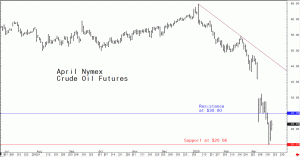
The Nymex crude oil futures market early this week is under pressure again and is not far above the recent four-year low. Bears are in solid near-term technical control and more downside price pressure looks likely in the near term, as the markets panic and global demand shock continue to play out, amid no signs of markets stabilization.

Filed Under: Blog News, Jim's Morning Report, Uncategorized

From bad to worse–U.S. stock index futures set to open limit down Monday

March 16, 2020 by Jim Wyckoff

Monday, March 16–Jim Wyckoff’s Morning Markets Report

Global stock markets were solidly lower in overnight trading. U.S. stock markets are pointed to sharply lower to limit-down trade ahead of the New York day session opening. Trader and investor confidence appears to be going from bad do worse to start the trading week, as over the weekend U.S. non-essential commerce began to shut down amid the coronavirus pandemic. Major stores are closing, public schools are closing, Colorado shut down all of its ski slopes and some states have ordered the closing of bars and restaurants. U.S. airlines are in financial peril as passenger traffic plummets. This follows the moves last week to effectively shut down most major sporting events in the U.S. The U.S. Center for Disease control has warned most Americans to stay home and recommended gatherings of 50 or more people be cancelled for at least the next two months.

The U.S. Federal Reserve on Sunday afternoon again cut its key interest rate, by 1.0% this time, to a range of zero to 0.25%. The Fed also will pump an additional $700 billion into the U.S. financial system (quantitative easing) and has opened up swap lines with other major central banks, in an effort to keep liquidity in the financial markets. President Trump and Congress over the weekend agreed on an aid bill for businesses and consumers negatively impacted by the virus outbreak. Speculation is that it will take at least two months for this situation to get under control from a U.S. public health perspective.

Other world central banks over the weekend announced further actions to thwart the negative economic impact of the virus outbreak that has created a demand shock worldwide.

Following is an edited portion of one email dispatch from a market analyst Monday morning: “It’s becoming evident that the major central banks across the globe are using all their available tools to prevent a crisis, but it seems the fear of the pandemic is taking control of investors. Markets will continue going through this phase of extreme volatility until they are able to assess the scale of damage caused by the virus outbreak. The longer the outbreak persists and countries stay in emergency status, the harder the global economy will be hit. A recession seems almost impossible to prevent at this stage, but the question remains, how bad is it going to be? Equity strategists will not be able to provide meaningful targets for stock prices. That’s because even companies themselves cannot project revenue targets in such situations.”

Economic data released by China Monday showed industrial production in the world’s second-largest economy plunged 13.5% in the first two months of 2020. Retail sales dropped 20.5% in the period as consumers were locked at home. Traders are wondering if the same dour economic numbers will start to come out of Europe and the U.S.

The benchmark 10-year U.S. Treasury note sees its yield around 0.8% Monday. The U.S. dollar index is solidly lower in early U.S. trading. Nymex crude oil prices are solidly down and trading around $30.00 a barrel.

U.S. economic data due for release Monday includes the Empire State manufacturing survey.

–Jim

Continue Reading

Filed Under: Blog News, Jim's Morning Report, Uncategorized

  • « Go to Previous Page
  • Page 1
  • Interim pages omitted …
  • Page 252
  • Page 253
  • Page 254
  • Page 255
  • Page 256
  • Interim pages omitted …
  • Page 423
  • Go to Next Page »

Footer

Disclaimer

There is a risk of financial loss in futures and options trading. Futures trading is neither easy nor an easy way to make money. It takes hard work to have success. Please use sound money management when trading futures. Past performance is not necessarily indicative of future results. Nothing on this website is intended to be a trading recommendation to buy or sell futures or options. All information has been obtained from sources believed to be reliable, but accuracy is not guaranteed. Readers are solely responsible for how they use the information on this website.

Latest trending facts

Copyright © 2026 · Atmosphere Pro on Genesis Framework · WordPress · Log in