The U.S. stock indexes are presently trapped in the technical grip of a big bear. See the steep price downtrend in place on the daily bar chart for the e-mini S&P futures. Importantly, the general public and traders and investors’ perceptions of the human and economic tolls of the Covid-19 near-pandemic are darkening by the day. Traders hate uncertainty, and the marketplace still does not have any grasp of how the coronavirus situation will ultimately play out from a markets perspective. Such fully favors the bearish equities camp.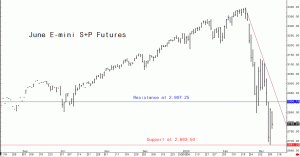
Daily Morning Report
General public, trader/investor moods regarding coronavirus continue to darken
Wednesday, March 11–Jim Wyckoff’s Morning Markets Report
Global stock markets were mostly lower Wednesday and U.S. stock indexes are pointed toward sharply lower openings when the New York day session begins. The higher volatility, yo-yo daily trading action recently favors the bearish camp. The coronavirus outbreak continues to spread, including in the U.S., where major conventions are being cancelled, some colleges are telling students to go home and U.S. airlines are reducing flights substantially.
The Bank of England cut its key interest rate by 0.5% overnight and the U.K. government said it is set to implement economic stimulus measures. The marketplace was a bit upset Tuesday when the Trump administration failed to announce any U.S. economic stimulus measures after President Trump hinted such might occur.
The general public and traders and investors’ perceptions of the human and economic tolls of the Covid-19 near-pandemic are darkening by the day. Traders hate uncertainty, and the marketplace still does not have any grasp of how the coronavirus situation will ultimately play out from a markets perspective.
The Saudi Arabia-Russia oil-price war and its global energy and economic ramifications remain on traders’ minds, and would normally be on the front burner of the marketplace if not for the coronavirus scare. Traders are wondering if the two major global oil producers might soon meet to reconcile their differences, as it appears both countries are “cutting off their nose to spite their face.”
The benchmark 10-year U.S. Treasury note sees its yield around 0.725% Wednesday, which is down from Tuesday’s reading. On Monday the U.S. 10-year note hit a record low yield of 0.387%.
The U.S. dollar index is trading weaker in early U.S. trading following sharp gains Tuesday. Nymex crude oil prices are down and trading around $33.25 a barrel.
U.S. economic data due for release Wednesday includes the weekly MBA mortgage applications survey, real earnings, the consumer price index, the weekly DOE liquid energy stocks report and the monthly Treasury budget statement.
–Jim
Second “shock” roils global markets: crude oil prices crash
Global stock, commodity and financial markets were rocked Monday following the surprise weekend news that Saudi Arabia said it would drastically lower its crude oil prices and pump more crude oil following a failed OPEC meeting in which Russia refused to lower its crude production. Nymex crude oil prices fell to a four-year low of $27.34 a barrel. The one-day loss in crude oil prices Monday is the biggest in almost 30 years, dating back to the 1991 first gulf war. The free-falling crude oil market is a very bearish harbinger for most of the rest of the raw commodity sector. More and more, it appears the global economy is spiraling into recession and a bear market in equities.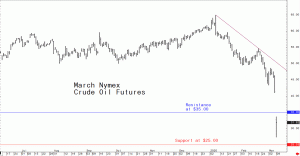
Saudi-Russia oil price war second “shock” to hit global marketplace in 2020
Monday, March 9–Jim Wyckoff’s Morning Markets Report
Global stock, commodity and financial markets were rocked overnight following the weekend news that Saudi Arabia said it would drastically lower its crude oil prices and pump more crude oil following a failed OPEC meeting in which Russia refused to lower its crude production. Nymex crude oil prices fell to a four-year low of $27.34 a barrel overnight before coming off those lows but still trading down nearly $9.00 a barrel at around $32.50. The one-day loss in crude oil prices is the biggest in almost 30 years, dating back to the 1991 first gulf war.
Global stock markets sold off sharply overnight and the U.S. stock index futures are pointed toward sharply lower to limit-down price moves when the New York day session opens.
The benchmark 10-year U.S. Treasury note saw its yield dive to a record low of 0.387% overnight, and its currently trading around 0.5%. The U.S. 30-year Treasury bond’s yield dropped below 1.0% overnight. U.S. Treasury bond futures overnight at one point saw prices trade over 13 points higher. For perspective, a one-point move in T-Bond prices (32/32) is normally consider a big move.
Gold prices soared above $1,700.00 an ounce and hit a seven-year high overnight before falling back to trade modestly down on the day, at around $1,666.00. Gold is likely being pressure by the old trading adage, “When you can’t sell what you want, you sell what you can,” as the e-mini S&P stock index futures were locked limit down overnight and the U.S. stock market has yet to open, as of this writing.
The U.S. dollar index is trading lower and hit a 13-month low overnight. The Japanese yen has soared on the foreign exchange market, while the Australian dollar plunged in value.
The Saudi-Russia oil-price war is the second shock to hit the global marketplace this year, as traders and investors are still dealing with the high anxiety of the coronavirus, or Covid-19 outbreak that continues to spread. Reports over the weekend said half of Italy is on lockdown, while more cases and deaths have been reported in the U.S. The state of New York has declared a state of emergency because of the outbreak. Business events in the U.S. are now being cancelled and some companies have banned employee travel on airlines.
More and more, it appears the global economy is spiraling into recession and a bear market in equities. Young investors have never experienced a bear market in stocks, which will especially unnerve them. Look for the major central banks to take more action—possibly as soon as Monday—to try to mitigate the collapsing stock markets and assuage very shaky consumer confidence.
U.S. economic data due for release Monday is light and includes the employment trends index.
–Jim
A scary Friday unfolding; stacking up the big market shocks–how this one ranks
Friday, March 6–Jim Wyckoff’s Morning Markets Report
Global stock markets were solidly lower overnight, following the big losses in the U.S. stock market on Thursday. U.S. stock indexes are again pointed toward sharply lower openings when the New York day session begins. Look for another very active day in U.S. markets. It’s hard to conceive the U.S. stock indexes recovering today, heading into another uncertain weekend and what next Monday may bring on the coronavirus front.
Here’s the latest on the Covid-19, or coronavirus, outbreak that continues to wreak havoc in world markets. Some U.K. factories have moved to a four-day work week. The impact on German and Euro zone automotive manufacturers is expected to be severe in the short term. Supply chain issues are creating the notion of companies securing greater supplies of critical parts and materials—also called hoarding.
Here are some selected comments from one of Friday’s market commentaries emailed to me: “Disinflationary risks mount and recession looks an increasingly safe bet (it’s simply a question of where, how deep and how long). Even Gold, normally an inflation hedge, is soaring on the basis of naked fear. Despite calming words about how this is just the flu and all will be well in a few months when the summer comes, nobody knows where we are heading with Covid-19. One thing seems pretty clear, if the market has presently priced Coronavirus in correctly, it is by sheer blind luck; probably it has not.”
Standard and Poors has forecast GDP growth in China at 4.8% in 2020 before rebounding to 6.6% in 2021.
The benchmark U.S. 10-year Treasury note yield overnight fell below 0.8% to another record low, and remains below that level. How low can the U.S. 10-year note yield go? Well, for perspective Germany’s 10-year bund is presently trading at a yield of -0.73%. There is dire concern among long-term market watchers that a U.S. and /or global economic recession looms, including the prospect of debilitating consumer and commercial price deflation.
From my 35-year markets-watching perspective: I can think of a few big market shocks that rival what is occurring now, including the Chernobyl nuclear accident in the Soviet Union in 1986, the Sept. 11 terror attacks in 2001, the 2008 global financial crisis, and the 1987 stock market meltdown. For me, only the 1987 stock market crash and the 9-11 attacks were bigger than what markets are exhibiting now. This coronavirus matter is a big deal that appears to be getting bigger.
The key outside markets today see Nymex crude oil prices sharply lower, hitting a 14-month low and trading around $44.00 a barrel in early trading. OPEC and Russia are presently wrangling regarding how much oil production the cartel should further restrict amid the falling prices. Meantime, the U.S. dollar index is trading sharply down today and hit a nine-month low.
The coronavirus scare has overshadowed today’s release of the U.S. employment situation report for February, from the Labor Department—arguably the most important U.S. data point of the month. The key non-farm payrolls number is forecast to come in up around 175,000.
Other U.S. economic data due for release Friday includes international trade in goods and services, monthly wholesale trade, and consumer credit.
–Jim
Continue Reading
Raw commodity market sector in trouble
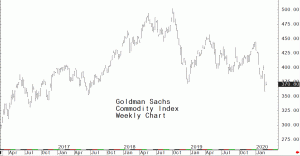
The benchmark U.S. 10-year Treasury note yield earlier this week fell below 1.0% to a record low, and remains below that level. This has prompted keen concern among long-term market watchers that a U.S. and /or global economic recession looms, including the prospect of debilitating consumer and commercial price deflation. That prospect is bearish for stocks and most commodities, and bullish for safe-haven assets like gold, the U.S. dollar and U.S. Treasuries. An examination of the weekly chart of the Goldman Sachs Commodity index paints a dour picture for the prospects for the raw commodity sector. The GSCI last week hit a nearly three-year low.