• Skip to main content
  • Skip to footer

Jim Wyckoff

Dominate Your Market

  • Daily Morning Report
  • Meet Jim
    • Testimonials
  • Contact Jim
  • Sample Reports and Charts
  • FAQ
  • Jim’s educational e-books

Daily Morning Report

Global markets panic may have finally climaxed early Friday

March 13, 2020 by Jim Wyckoff

Friday, March 13–Jim Wyckoff’s Morning Markets Report

Most global stock markets rebounded Friday. U.S. stock indexes are pointed toward solidly higher openings when the New York day session begins, following Thursday rout that saw the biggest daily losses in the Dow Jones Industrial Average since the 1987 stock market crash. U.S. stock indexes are still firmly in bearish territory—down more than 20% from their record highs scored in February.

Here’s the key question on veteran traders’ and investors’ minds: At what point will general capitulation occur in markets that have been pounded lower? That means traders/investors already under pressure to get rid of their rapidly depreciating assets just throw up their hands and succumb to the financial pressures on them, and sell—suggesting selling has finally become exhausted and market bottoms are in place. It can be argued that Thursday’s price action showed some signs of capitulation. There was “blood on the Street.” Safe-haven gold and U.S. Treasury bond and note futures prices were hammered Thursday as traders sold what assets they could after U.S. stock index futures trading was halted in morning dealings after prices locked down their daily trading limits. Said one trader of Thursday’s price action: “There was nowhere to hide.”

Psychologically, the cancellation Thursday of most major U.S. sporting and major public events for at least the next several weeks dealt the general trading/investing public a surprising blow that arguably won’t be topped during this crisis. If the U.S. stock indexes post good closing gains on this Friday the 13th, (right now that’s a big if), then there will be more than a few long-time market watchers, including this one, who will think this major global market shock has hit its climax, from a markets perspective. If so, markets next week would begin to stabilize and stock indexes likely will have put in their market-crisis bottoms.

Major central banks of the world on Friday continued to take actions to thwart the economic damage caused by the coronavirus outbreak that continues to spread, including in the U.S. Norway’s central bank lowered interest rates while the European Central Bank Friday worked to assuage European traders disappointed by the ECB’s stimulatory actions announced Thursday. The ECB said Friday that more actions by the bank are possible in the near term. Meantime, China’s central bank lowered its reserve requirement ratio for its banks, to free up more cash for consumer loans. These moves follow Thursday’s massive injection of short-term liquidity into the U.S. financial system by the Federal Reserve around midday.

The benchmark 10-year U.S. Treasury note sees its yield around 0.9% Friday, which is well up from Thursday’s reading and also suggestive of a stabilizing global marketplace. The U.S. dollar index is trading a bit weaker in early U.S. trading, but it appears the greenback is finally getting a safe-haven bid as marketplace anxiety levels rise. The Euro currency is slumping this week, as well as the “commodity currencies”—the Canadian dollar and the Australian dollar. The crypto currency market has been hammered this week, as Bitcoin prices late this week hit a nearly one-year low.

Nymex crude oil prices are solidly up Friday morning and trading around $33.00 a barrel.

U.S. economic data due for release Friday includes import and export prices and the University of Michigan consumer sentiment survey

–Jim

Continue Reading

Filed Under: Blog News, Jim's Morning Report, Uncategorized

U.S. stock market is now in bear territory as markets in a panic over Covid-19

March 12, 2020 by Jim Wyckoff

Thursday, March 12–Jim Wyckoff’s Morning Markets Report

Global stock markets were sharply lower overnight and U.S. stock index futures are pointed toward sharply lower to limit-down openings when the New York day session begins. U.S. stock indexes are now in bear market territory—down more than 20% from their peaks that occurred just last month.

The Covid-19 pandemic has the global marketplace in panic. President Trump’s Oval Office speech to the American citizens Wednesday night seemed to cause further unease in the markets when he announced no major economic stimulus measures, saying that’s up to the U.S. Congress. On Wednesday evening the NBA basketball league suspended its season after a player contracted coronavirus. The CME Group has closed its trading floors; however, most futures markets have been trading electronically for years. Movie stars Tom Hanks and his wife announced on Twitter they have tested positive for the illness. There are scattered reports the U.S. Treasury markets are becoming stressed.

Following is an edited version of Thursday morning email dispatch from a market analyst: “Markets are in complete crisis mode; past economic data has zero influence on investors’ decisions; central bank emergency easing policies are not being effective and politicians’ actions are only adding more confusion. The one thing that investors are monitoring is how fast the coronavirus is spreading. President Trump’s address to the nation last night was underwhelming. It shows that the U.S., like many other countries, is unable to provide the right action in response to the virus spread. A global recession seems impossible to escape and a massive decline in corporate earnings is inevitable. What is even more worrying is the risks that come with such a recession. Corporates across the globe are over-leveraged after more than a decade of low interest rates, and companies with weak balance sheets are extremely vulnerable to such economic shocks.“

The European Central Bank at its meeting Thursday is expected to announce monetary policy stimulus measures to battle the negative economic effects of the Covid-19 outbreak. With ECB interest rates already below zero, the central bank has limited options on stimulus. At this point, some economists are saying the Euro zone gross domestic product will decline 1.2% in 2020.

The benchmark 10-year U.S. Treasury note sees its yield around 0.68% Wednesday, which is well down from Wednesday’s reading. The U.S. dollar index is trading solidly up in early U.S. trading, as it appears the greenback is getting a safe-haven bid as marketplace anxiety levels rise. Nymex crude oil prices are sharply down and trading around $31.25 a barrel.

U.S. economic data due for release Thursday includes the weekly jobless claims report and the producer price index. Traders and investors are paying little attention to economic reports, at present.

–Jim

Continue Reading

Filed Under: Blog News, Jim's Morning Report, Uncategorized

U.S. stock indexes trapped in the jaws of a bear

March 11, 2020 by Jim Wyckoff

The U.S. stock indexes are presently trapped in the technical grip of a big bear. See the steep price downtrend in place on the daily bar chart for the e-mini S&P futures. Importantly, the general public and traders and investors’ perceptions of the human and economic tolls of the Covid-19 near-pandemic are darkening by the day. Traders hate uncertainty, and the marketplace still does not have any grasp of how the coronavirus situation will ultimately play out from a markets perspective. Such fully favors the bearish equities camp.

Filed Under: Blog News, Jim's Morning Report, Uncategorized

General public, trader/investor moods regarding coronavirus continue to darken

March 11, 2020 by Jim Wyckoff

Wednesday, March 11–Jim Wyckoff’s Morning Markets Report

Global stock markets were mostly lower Wednesday and U.S. stock indexes are pointed toward sharply lower openings when the New York day session begins. The higher volatility, yo-yo daily trading action recently favors the bearish camp. The coronavirus outbreak continues to spread, including in the U.S., where major conventions are being cancelled, some colleges are telling students to go home and U.S. airlines are reducing flights substantially.

The Bank of England cut its key interest rate by 0.5% overnight and the U.K. government said it is set to implement economic stimulus measures. The marketplace was a bit upset Tuesday when the Trump administration failed to announce any U.S. economic stimulus measures after President Trump hinted such might occur.

The general public and traders and investors’ perceptions of the human and economic tolls of the Covid-19 near-pandemic are darkening by the day. Traders hate uncertainty, and the marketplace still does not have any grasp of how the coronavirus situation will ultimately play out from a markets perspective.

The Saudi Arabia-Russia oil-price war and its global energy and economic ramifications remain on traders’ minds, and would normally be on the front burner of the marketplace if not for the coronavirus scare. Traders are wondering if the two major global oil producers might soon meet to reconcile their differences, as it appears both countries are “cutting off their nose to spite their face.”

The benchmark 10-year U.S. Treasury note sees its yield around 0.725% Wednesday, which is down from Tuesday’s reading. On Monday the U.S. 10-year note hit a record low yield of 0.387%.

The U.S. dollar index is trading weaker in early U.S. trading following sharp gains Tuesday. Nymex crude oil prices are down and trading around $33.25 a barrel.

U.S. economic data due for release Wednesday includes the weekly MBA mortgage applications survey, real earnings, the consumer price index, the weekly DOE liquid energy stocks report and the monthly Treasury budget statement.

–Jim

Continue Reading

Filed Under: Blog News, Jim's Morning Report, Uncategorized

Second “shock” roils global markets: crude oil prices crash

March 9, 2020 by Jim Wyckoff

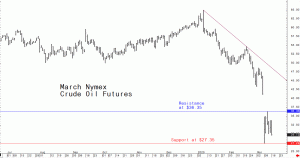
Global stock, commodity and financial markets were rocked Monday following the surprise weekend news that Saudi Arabia said it would drastically lower its crude oil prices and pump more crude oil following a failed OPEC meeting in which Russia refused to lower its crude production. Nymex crude oil prices fell to a four-year low of $27.34 a barrel. The one-day loss in crude oil prices Monday is the biggest in almost 30 years, dating back to the 1991 first gulf war. The free-falling crude oil market is a very bearish harbinger for most of the rest of the raw commodity sector. More and more, it appears the global economy is spiraling into recession and a bear market in equities.

Filed Under: Blog News, Jim's Morning Report, Uncategorized

Saudi-Russia oil price war second “shock” to hit global marketplace in 2020

March 9, 2020 by Jim Wyckoff

Monday, March 9–Jim Wyckoff’s Morning Markets Report

Global stock, commodity and financial markets were rocked overnight following the weekend news that Saudi Arabia said it would drastically lower its crude oil prices and pump more crude oil following a failed OPEC meeting in which Russia refused to lower its crude production. Nymex crude oil prices fell to a four-year low of $27.34 a barrel overnight before coming off those lows but still trading down nearly $9.00 a barrel at around $32.50. The one-day loss in crude oil prices is the biggest in almost 30 years, dating back to the 1991 first gulf war.

Global stock markets sold off sharply overnight and the U.S. stock index futures are pointed toward sharply lower to limit-down price moves when the New York day session opens.

The benchmark 10-year U.S. Treasury note saw its yield dive to a record low of 0.387% overnight, and its currently trading around 0.5%. The U.S. 30-year Treasury bond’s yield dropped below 1.0% overnight. U.S. Treasury bond futures overnight at one point saw prices trade over 13 points higher. For perspective, a one-point move in T-Bond prices (32/32) is normally consider a big move.

Gold prices soared above $1,700.00 an ounce and hit a seven-year high overnight before falling back to trade modestly down on the day, at around $1,666.00. Gold is likely being pressure by the old trading adage, “When you can’t sell what you want, you sell what you can,” as the e-mini S&P stock index futures were locked limit down overnight and the U.S. stock market has yet to open, as of this writing.

The U.S. dollar index is trading lower and hit a 13-month low overnight. The Japanese yen has soared on the foreign exchange market, while the Australian dollar plunged in value.

The Saudi-Russia oil-price war is the second shock to hit the global marketplace this year, as traders and investors are still dealing with the high anxiety of the coronavirus, or Covid-19 outbreak that continues to spread. Reports over the weekend said half of Italy is on lockdown, while more cases and deaths have been reported in the U.S. The state of New York has declared a state of emergency because of the outbreak. Business events in the U.S. are now being cancelled and some companies have banned employee travel on airlines.

More and more, it appears the global economy is spiraling into recession and a bear market in equities. Young investors have never experienced a bear market in stocks, which will especially unnerve them. Look for the major central banks to take more action—possibly as soon as Monday—to try to mitigate the collapsing stock markets and assuage very shaky consumer confidence.

U.S. economic data due for release Monday is light and includes the employment trends index.

–Jim

Continue Reading

Filed Under: Blog News, Jim's Morning Report, Uncategorized

  • « Go to Previous Page
  • Page 1
  • Interim pages omitted …
  • Page 253
  • Page 254
  • Page 255
  • Page 256
  • Page 257
  • Interim pages omitted …
  • Page 423
  • Go to Next Page »

Footer

Disclaimer

There is a risk of financial loss in futures and options trading. Futures trading is neither easy nor an easy way to make money. It takes hard work to have success. Please use sound money management when trading futures. Past performance is not necessarily indicative of future results. Nothing on this website is intended to be a trading recommendation to buy or sell futures or options. All information has been obtained from sources believed to be reliable, but accuracy is not guaranteed. Readers are solely responsible for how they use the information on this website.

Latest trending facts

Copyright © 2026 · Atmosphere Pro on Genesis Framework · WordPress · Log in